As an Amazon Associate, we earn from qualifying purchases. Some links on this site are affiliate links at no extra cost to you. Our recommendations are based on thorough research and editorial judgment.


What’s The Best Approach For Hitting Different Pitch Types?

The best approach for hitting different pitch types starts with understanding pitch characteristics. Recognizing fastballs, typically 85-100 mph, requires quick identification and timing adjustments. Mastery of off-speed pitches like sliders (80-90 mph) and curveballs involves discipline in observing pitch trajectories. Adjusting swing mechanics, such as stance width and timing, enhances contact quality. Utilizing data and technology provides insights for targeted training. Developing a personalized hitting plan based on pitch sequences can further refine strategies. Discover more actionable techniques here.
Key Takeaways
- Master pitch recognition by observing the pitcher’s grip and arm speed to quickly differentiate between fastballs and off-speed pitches.
- Adjust swing mechanics according to pitch types; use a compact load for fastballs and a longer load for off-speed pitches.
- Incorporate simulation drills to practice timing, pitch recognition, and responses to various pitch types in a game-like scenario.
- Leverage technology and data analytics to understand pitch trends and improve your approach to different pitches through real-time feedback.
- Develop personalized hitting plans that focus on specific pitcher tendencies and incorporate pitch sequencing for enhanced situational awareness.
Understanding Pitch Types and Their Characteristics
You may be interested



Understanding pitch types and their characteristics is essential for any aspiring batter. Accuracy in pitch classifications helps hitters anticipate what’s coming. Fastballs, like the 4-seam, range from 85-100 mph with minimal movement, while 2-seamers and sinkers drop vertically, slowing just a few mph. Cutters can deceive by moving glove-side. Breaking balls, including sliders and curveballs, feature distinct movement dynamics; sliders have lateral break, while curveballs create sharp vertical drops. Off-speed pitches, such as changeups and their slower variants, disrupt timing. Hitter adjustments rely on recognizing pitch trajectory and understanding velocity ranges and spin rates. Mastering these factors enhances a batter’s ability to read arm angles and respond to deception techniques effectively. Additionally, using high-quality batting gloves can significantly improve grip and control when facing various pitch types.
Recognizing Fastballs and Timing Adjustments

Recognizing fastballs is pivotal for any batter looking to enhance their hitting performance. Fastballs typically travel at 85-100 mph, requiring quick identification and effective velocity calibration. Batters should focus on anticipatory cues, such as the pitcher’s grip and arm speed, to differentiate fastballs from off-speed pitches. This recognition allows for timely swing initiation, which takes less than 500 milliseconds, with the brain needing 100 milliseconds to process visual cues. Hitters can adjust their timing for faster pitches, especially those above 95 mph, honing their skills through consistent exposure. Utilizing a loading phase in their stance enables hitters to prepare for fast decision-making, improving their chance of success against these challenging pitches. Adjustable height options can also aid batters in practicing their timing and swing mechanics effectively.
Mastering Off-Speed Pitches: Sliders and Curveballs

Mastery of off-speed pitches such as sliders and curveballs can greatly elevate a batter’s hitting game. Understanding slider mechanics is key; these pitches travel at 80-90 mph, featuring high gyroscopic spin and late lateral breaks. Hitters should anticipate this movement, recognizing the sharp motion towards a right-handed pitcher’s glove side. Meanwhile, curveball strategies hinge on spin rates, generally between 2430 to 2900 rpms. This creates significant vertical drop and looping action. Batters must stay disciplined, watching for the rise and fall of these pitches. Practicing recognition and timing against both types of off-speed pitches guarantees a more complete hitting approach, allowing players to embrace varied pitching styles with confidence on the diamond. Incorporating tools like GoSports Weighted Training Balls can further enhance a batter’s strength and accuracy while facing these challenging pitches.
Adjusting Your Swing Mechanics for Different Pitches

Adjusting swing mechanics for different pitches is fundamental for any hitter aiming to improve performance at the plate. Swing adjustments should start with altering stance width to boost balance and readiness for pitch speed and movement. A longer load time helps with slower pitches, while a compact load aids in reacting to fastballs. Timing is critical; initiating the swing earlier for fastballs and delaying for off-speed pitches enhances contact. Adjusting bat path keeps it on plane with the pitch’s trajectory, maximizing contact quality. Effective hip rotation—quick for fastballs and controlled for breaking pitches—helps sync lower body mechanics. Finally, a complete follow-through guarantees energy transfer and maintains swing integrity, making these pitch adaptations essential for every player’s success. Additionally, the responsiveness of modern materials in equipment can contribute to improved performance, allowing players to focus on their mechanics without being hindered by their gear.
Cognitive Pitch Recognition: Visual and Mental Strategies

Cognitive pitch recognition serves as an essential skill for hitters, determining their success at the plate. Expert hitters leverage cognitive strategies and visual cues, identifying pitches swiftly, particularly at distances between 32 and 40 feet. Their ability to anticipate based on pitcher kinematics fosters improved pitch discrimination. Mental imagery techniques, like imagery-assisted virtual reality, enhance recognition and refine neural patterns essential for effective hitting. Continuous feedback adaptation further sharpens decision-making skills, allowing hitters to adjust their mental model over time. In situational contexts, such as pitch counts, awareness becomes critical for achieving performance enhancement. By integrating these strategies, batters can markedly improve their accuracy and response time when facing diverse pitch types, heightening their overall game effectiveness. Additionally, utilizing tools like the Hikeen Baseball Softball Swing Trainer can support practice in pitch recognition by offering adjustable training features that cater to various skill levels.
Strategic Approaches to Hitting Based on Pitch Type
How can hitters enhance their approach to dealing with various pitch types? Strategic timing strategies are vital for adapting to specific pitches. For fastballs, mastering precise timing combined with a line-drive approach improves contact. Hitters should also focus on pitch location, adjusting their swing path to catch inside offerings earlier or loft low pitches for better results. With breaking balls, employing swing patience is essential; recognizing a slider’s lateral movement early allows for necessary adjustments. When facing offspeed pitches like changeups, using subtle visual cues can greatly boost timing adaptation. Ultimately, successful hitters blend these strategies, recognizing each pitch’s unique characteristics and adjusting their mechanics accordingly to maximize performance at the plate. Additionally, incorporating adjustable heights in training tools like batting tees can help players practice effectively for different pitch types.
Leveraging Data and Technology for Hitting Improvement
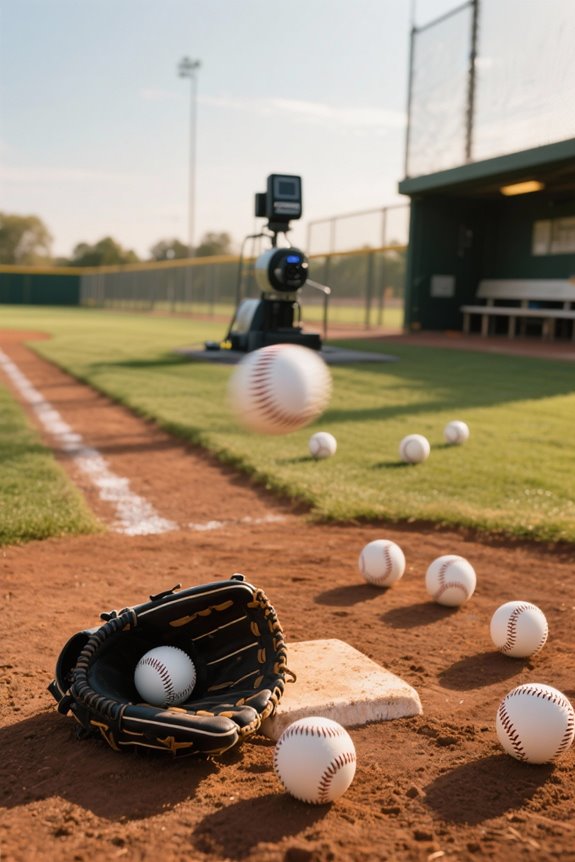
Enhancing hitting performance today relies greatly on data and technology. Pitch tracking systems like Trackman and Rapsodo measure pitch speed and spin rate with impressive accuracy. These advancements provide thousands of data points per pitch. Real-time feedback allows hitters to adjust their approaches based on pitch types instantly. Wearable technologies, like Catapult Vector, monitor workloads, ensuring players train effectively and reduce injury risks. Video integration accompanies pitch data, enabling players to analyze their swings visually. Biomechanical insights refine swing mechanics, optimizing timing against diverse pitches. Altogether, data analytics and technological advancements foster a data-driven environment, empowering hitters to adapt their strategies and improve their performance effectively. This collective approach enhances player development, making training more targeted and informed. Additionally, incorporating automatic pitching machines can simulate various pitch types, further enhancing practice effectiveness.
Crafting a Personalized Hitting Plan Based on Pitch Sequences
Crafting a personalized hitting plan based on pitch sequences empowers hitters to maximize their performance at the plate. This approach considers the unique strengths of each batter. Power hitters face more off-speed and breaking pitches, while contact hitters see more movement. Incorporating pitch sequencing into training allows hitters to anticipate pitches based on game situations—like the number of outs or runners on base. Recognizing early-count fastballs helps set timing, while preparing for breaking pitches late enhances effectiveness. Drills that simulate pitch tunnels strengthen situational awareness and adaptability. By understanding a pitcher’s tendencies and adjusting to pitch types, hitters can develop a strategy that transforms their performance, making them more competitive at the plate in various scenarios. Utilizing weighted training balls during practice can greatly enhance strength and mechanics, further supporting a hitter’s development.
Frequently Asked Questions
How Does Weather Affect Pitch Behavior During a Game?
Weather substantially impacts pitch behavior during a game; temperature variations alter grip and velocity, humidity effects influence ball flight, wind influence affects trajectory, and precipitation impact complicates control, collectively shaping pitcher performance and effectiveness.
What Role Does a Pitcher’s Delivery Style Play in Pitch Recognition?
A pitcher’s delivery style greatly impacts pitch recognition, as consistent pitching mechanics enhance predictability. Variability in delivery consistency might confuse hitters, making it challenging to anticipate pitch types and improve their overall timing and reaction skills.
How Can a Batter Practice Timing for Different Pitch Types?
A batter can enhance timing for different pitch types through timing drills and pitch simulations. These practices develop reaction speed, improve anticipation, and create a communal experience among players, fostering a sense of belonging and skill advancement.
What Psychological Techniques Can Help Reduce Anxiety During At-Bats?
Mindfulness techniques and visualization exercises effectively reduce anxiety during at-bats. They enhance focus, build confidence, and recreate successful experiences, fostering a supportive environment where batters feel connected and empowered to perform their best under pressure.
How Essential Is Communication Between Hitters and Coaches During Games?
Effective communication between hitters and coaches is essential, contrasting silence with clarity. Coach feedback enhances game strategy, fostering a shared sense of belonging and trust that empowers players to respond confidently to evolving in-game dynamics.