As an Amazon Associate, we earn from qualifying purchases. Some links on this site are affiliate links at no extra cost to you. Our recommendations are based on thorough research and editorial judgment.


What’s The Proper Way To Track Fly Balls In The Outfield?

To effectively track fly balls in the outfield, players should start with their feet shoulder-width apart and knees bent. Focus on the ball as soon as it is hit. Use environmental cues, like the ball’s spin, to gauge its trajectory. Quick, lateral foot movements help align body posture with the ball path. Glove fingers should point up for better visibility. Engaging in specific drills boosts reaction time and confidence. There are many more strategies to master this skill.
Key Takeaways
- Maintain a ready position with feet shoulder-width apart and knees bent to ensure quick movement as the ball is hit.
- Keep your eyes locked on the ball and monitor its spin and trajectory for accurate tracking.
- Initiate movement immediately after the ball is struck, using a drop step for effective positioning.
- Communicate clearly with teammates to avoid confusion, establishing designated areas for each outfielder.
- Practice drills focused on reaction time and footwork to enhance tracking skills during live play.
Initial Positioning and Stance
You may be interested



In the outfield, every successful play begins with the ideal initial positioning and stance. Players should adopt a ready position with feet shoulder-width apart, knees slightly bent, and weight shifted to the balls of the feet. This stance enhances balance while enabling quick reactions. Body alignment is essential; shoulders and hips must face perpendicular to the expected ball’s flight path. Glove hands should be forward and relaxed, fingers up for various catch angles. A drop step initiates movements, setting up deeper positioning in response to the hit. By maintaining a low center of gravity, players can pivot effectively and change direction swiftly. Consistent practice of these fundamentals fosters confidence, enhancing overall performance on the field. Additionally, using a glove with adjustable wrist closures can improve fit and comfort, allowing players to focus more on tracking the ball rather than adjusting their equipment.
Reading and Tracking the Ball

Tracking fly balls effectively requires keen focus and quick reactions. Players must keep their eyes locked on the ball immediately after it is hit to accurately assess its ball flight path. Staying aware of the hitter’s tendencies helps predict the ball’s direction, reducing reaction time. Environmental cues, such as the angle of the sun or the cap’s brim, guide adjustments for height and distance. Consistent visual perception enhances depth awareness, essential for catching success. Players should monitor the ball’s spin, as it can curve or fade, affecting its landing. By practicing drills that focus on these skills, they can refine their ability to read and track the ball, promoting consistent performance in the outfield. Incorporating techniques used in batting stance training can also improve overall tracking and reaction times.
First Movement and Footwork

The first movement in tracking a fly ball is essential for an outfielder’s success. This initial action begins immediately after the ball is hit, allowing outfielders to gain a significant advantage. By utilizing pivot mechanics, the pivot foot is kicked back at an angle that corresponds to the ball’s trajectory—left foot back for leftward fly balls. This sets the stage for ideal lateral agility. Quick lateral steps are essential for aligning the body with the ball’s path, preventing flat-footedness that could slow reaction time. A slightly lowered stance promotes better balance, enabling a swift first step. Training drills like drop steps and cone drills enhance these skills, ensuring outfielders are ready to respond effectively to varying ball angles and speeds. Additionally, applying well-structured lessons from training resources can significantly improve tracking techniques.
Recommended Products

Works on both the offensive and defensive aspects of the game

Patrick Mahomes football training shoes for kids to unlock their inner MVP

【TRAINING EXPLOSIVE FORCE 】: Run faster, jump higher and dig harder with resistance Trainer that builds strength, agility , flexibility,dynamic power and overall balance.Build strength and explosive force as you take your physical skill to the next level.
Positioning for the Catch

How can an outfielder increase their chances of making a successful catch? Proper body alignment is essential. Outfielders should adopt a half-crouch stance with hands resting on their thighs, ensuring quick movement when the ball is hit. This position resembles a defensive basketball stance, with feet wider than shoulder-width and knees bent. The initial foot placement should allow for immediate push-off, often with a slight 45-degree step to gain momentum. Employing effective pivot techniques helps outfielders respond swiftly to the ball’s trajectory based on hitter tendencies and spin types. By anticipating where the ball will land and adjusting accordingly, outfielders can greatly enhance their success rate in catching fly balls. Additionally, practicing with premium materials in batting gloves can help improve grip and control while tracking fly balls effectively.
Glove and Hand Technique

Mastering glove and hand technique greatly increases an outfielder’s effectiveness when catching fly balls. Maintaining glove fingers pointed upwards improves visibility and readiness. Outfielders should keep the glove slightly open and relaxed to absorb impact and reduce jarring rebounds. Hand positioning is vital; using the throwing hand as a backup secures the ball immediately after the catch, while practicing two-hand catching drills enhances control. For high balls, open wider with the glove’s palm facing up. Glove exercises focusing on coordination and reaction time are essential for success. Ultimately, staying engaged in drills can improve both glove technique and hand skills, allowing for seamless gliding into action and making pivotal plays feel natural on the field. Incorporating ground ball trainers into your practice routine can further enhance your catching skills and overall performance.
Recommended Products

HANDCRAFTED WITH PRIDE IN THE USA - Since 1934, Nokona premium baseball gloves have been crafted by skilled American workers, using the world's highest quality & performance leathers to produce the finest gloves

HANDCRAFTED WITH PRIDE IN THE USA - Since 1934, Nokona premium baseball gloves have been crafted by skilled American workers, using the world's highest quality & performance leathers to produce the finest gloves

Wilson 2026 A2000 Classic B23 12" Baseball Pitcher Glove - Right Hand Throw, Saddle Tan/Blonde
Adjusting to Different Ball Trajectories
Understanding different ball trajectories is essential for outfielders, as each hit presents unique challenges. The trajectory and movement of a fly ball hinge on initial speed, angle of elevation, and ball spin. Outfielders must engage in trajectory analysis to anticipate the drop zone effectively. Starting low and balanced allows for quick adjustments, while gauging a batter’s tendencies helps shape initial positioning. Experience is vital; recognizing the type of hit, such as a line drive or high fly ball, improves predictive accuracy. Footwork and agility training, like cone drills, enhances their reaction time. By mastering these elements, players foster a deeper connection to the game, raising their performance while embracing the excitement of each play. Incorporating quality materials in construction into practice equipment can also significantly enhance training effectiveness.
Playing Wind Conditions
Outfielders face new challenges when playing in windy conditions that can dramatically alter the path of a fly ball. Wind awareness is vital, as it influences how far and in which direction a ball travels. Initially, outfielders should pause to assess wind direction and speed, avoiding the temptation to rush. Proper body alignment and the drop step technique enhance balance and focus, allowing adjustments as the wind affects the ball’s trajectory. Continuous movement is significant; keeping pace with the unpredictable nature of the ball guarantees effective catches. Practicing in these conditions, including drills that simulate wind’s unpredictable movement, helps players adapt and sharpen their skills in varying environmental factors. Agility ladder training can also improve an outfielder’s footwork, enabling them to react more effectively to changing conditions. With experience, an outfielder becomes proficient at tracking fly balls despite challenges.
Recommended Products


Portable & Easy Setup: The Roll Out training ladder offers quick setup for agility drills anywhere. Simply roll it out to create a stable 15-foot training surface that stays in place to help you focus on movement precision and form.

Durability and Strenuous Training Support: our rubber training ladder for footwork is made with quality rubber, providing durability; The material ensures dependability during your high intensity workouts; No need to worry about longevity or reliability, it's built to last!
Importance of Anticipation
Anticipation plays an essential role in an outfielder’s success on the field, especially as the ball leaves the bat. Effective anticipation starts with analyzing batter tendencies and pitch recognition. By understanding whether a batter typically pulls or hits to the opposite field, an outfielder can predict ball trajectories. Recognizing pitch types, like fastballs or curveballs, informs expected flight paths. This mental preparation allows for ideal positioning and shorter reaction times, greatly improving the chance of catching fly balls.
Maintaining visual focus is vital throughout the ball’s journey. By tracking the ball’s spin and movement, outfielders adjust their positioning better. Adopting quick foot movements and pivoting toward the anticipated landing spot enhances overall catch efficiency. With consistent practice, anticipation becomes second nature. Engaging in drills with baseball training aids can further enhance an outfielder’s ability to read and react to fly balls effectively.
Communicating With Teammates
Effective communication among teammates is paramount in the outfield. Establishing clear communication styles early on helps create strong team dynamics. Using consistent verbal calls like “I got it” guarantees that everyone knows who is taking the ball, preventing confusion and collisions. Coaches recommend making these calls loud and clear when the ball is hit to promote quick reaction. Each outfielder should have designated areas to reduce overlap and confusion about responsibility. Nonverbal techniques, such as eye contact and hand signals, can enhance coordination when voices can’t be heard. Finally, team members should signal their readiness to back up each other, reinforcing trust and improving overall performance. Strong communication forms the backbone of effective outfield play, which is essential for developing swing mechanics.
Drills for Improving Reaction Time
Improving reaction time is essential for outfielders looking to enhance their performance on the field. One effective approach includes a variety of reaction time drills. The Reaction Pop-Up Drill develops hand-eye coordination by having players catch balls tossed from different heights and directions while focusing on foot movement. Another engaging option is the Fly Ball Competition Drill, where players must catch multiple tosses, enhancing their judgment and agility. The Zig Zag Drill emphasizes efficient footwork and prepares players to track fly balls in real-game scenarios. In addition, the Self Toss and Box Drill trains spatial awareness, while utilizing squishy balls adds a fun twist. Each drill variation offers a unique benefit, ensuring thorough development of reaction time skills. Incorporating tools like weighted training balls can further enhance strength and performance during these drills.
Recommended Products

Includes 4-dozen Youth League Pearl Baseballs and Rutsch Bucket with Lid.

Training Design: Specially engineered offset weighted baseball designed for pitch development and command training, featuring a unique 7oz weight distribution

Country Of Origin: China
Building Confidence Through Practice
Confidence development in outfielders hinges on structured practice routines that mimic real-game situations. Engaging in focused drills helps reinforce confidence, especially when practitioners visualize successful catches. Establishing a pre-pitch routine prepares players mentally, while proper breathing techniques reduce anxiety. Timed drills under simulated pressure enhance mental resilience. Gradually increasing drill complexity, from easy catches to more challenging fly balls, builds confidence incrementally. Communication, like calling for the ball, fosters assertiveness, while practicing under various conditions allows players to adapt. Repeated practice of critical footwork and reaction skills strengthens reliable habits. Overall, these structured practices and positive reinforcement create a robust foundation for confidence, enhancing performance when it truly counts.
Analyzing Game Situations
Analyzing game situations is a key skill for outfielders, influencing their performance during critical moments on the field. Effective situational awareness allows players to anticipate runner advances and react accordingly. Knowing the number of outs, base runners, and the game’s context assists in deciding whether to focus on the catch or positioning for a quick throw. Outfielders should communicate with teammates to enhance defensive coverage and avoid collisions. Adjustments based on the batter’s tendencies and the ball’s spin are essential for maintaining ideal game strategy. Recognizing how factors like wind affect ball trajectory enables outfielders to adjust positioning effectively, improving chances of securing the catch and making a successful play.
Tips for Transitioning From Catch to Throw
Shifting from catch to throw is an important skill for outfielders looking to make quick, effective plays. Proper body positioning begins immediately after the catch; adjust your stance with feet shoulder-width apart and knees slightly bent. Shield your glove to minimize fumbling, and turn your throwing-side shoulder toward the target. The transfer technique should keep your eyes on the ball as you smoothly move it to your throwing hand, using a compact motion. Engage your hips and shoulders during the throw, stepping into it for power. Incorporate a crow hop for deep catches to maximize distance. Communication is crucial; call clearly for the ball, and always scan the field before throwing to guarantee a smart play.
Recommended Products

Wilson 2024 A2000 PF50SS 12.25” Outfield Baseball Glove - Right Hand Throw

SuperSnakeSkin is a microfiber material that’s half the weight of Pro Stock Leather, but twice as durable - in an all-new textured design. Its moisture-resistance extends the longevity of the glove, and is easier to clean than traditional leather

Mizuno GMP-7000D Mizuno Pro | Premium Outfielder Baseball Glove | 12.75" | Deep Pocket | Cross 6 Web
Player Pocket Designs: Pockets tailored specifically to the player's needs and how they prefer to break-in their glove. Recommendations: Middle Infielders, Shortstops and 3B.
Frequently Asked Questions
How Can I Improve My Overall Outfield Agility and Speed?
To improve overall outfield agility and speed, one should integrate outfield drills and speed exercises, focusing on plyometrics, sprinting, and agility practices. This training enhances quick movements, encourages teamwork, and fosters a sense of belonging in practice.
What Should I Do if I Misjudge a Fly Ball?
Upon misjudging a fly ball, one should quickly reorient, adjust footwork, and communicate with teammates. Utilizing misjudgment techniques enhances recovery chances, fostering a supportive team environment and promoting collective growth after errors.
How Do I Deal With Bright Sunlight While Tracking a Fly Ball?
To manage bright sunlight while tracking fly balls, one should employ sun glare strategies, utilizing optical adjustments like head tilts and proper positioning to minimize glare, ensuring better focus and improved chances of successful catches.
What Equipment Aids Are Available for Fly Ball Training?
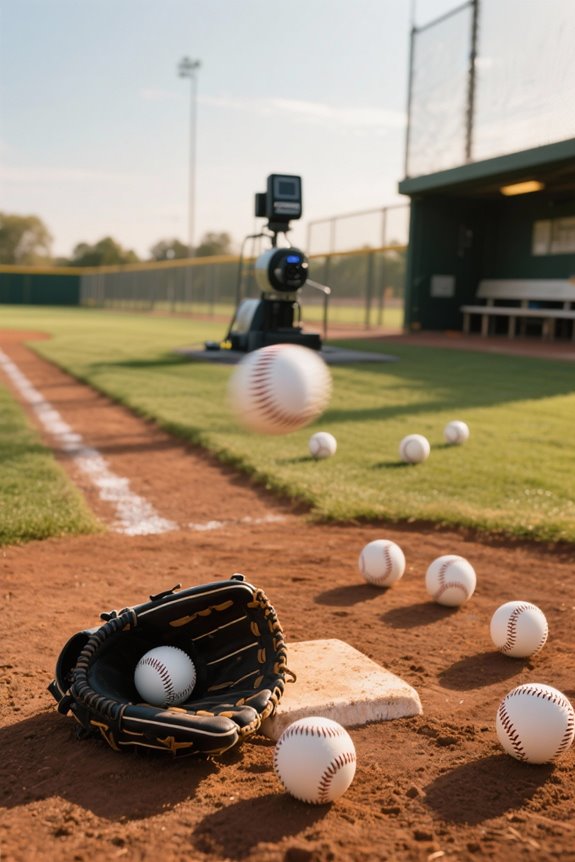
Catching aids and training tools, reminiscent of ancient archery techniques, enhance fly ball skills. From automated ball launchers to wearable tech, such equipment fosters a sense of community among players, encouraging growth and camaraderie in pursuit of excellence.
How Can I Maintain Focus During Long Games or Tournaments?
To maintain focus during long games or tournaments, individuals develop mental stamina through consistent game preparation, utilizing techniques like visualization, mindfulness, and setting small goals, fostering a sense of belonging and shared purpose among teammates.